REVIEW · CHIANG MAI
Chiang Mai: Chiang Rai Highlights in One Day
Book on GetYourGuide →Operated by MOONG TOUR · Bookable on GetYourGuide
Two surreal temples in one packed day. You get the wow factor of the White Temple plus the vivid drama of the Blue Temple, with big statues and art stops rounding out the day. One thing to consider: it is a long ride on the van, and you may not get a deep temple lecture inside each site.
I like that the tour is built for momentum. You start early (meeting at Starbucks, Tha Phae Gate at 7:30 a.m.), then you move through the day with an English-speaking guide, with people reporting guides like Wanida, Goi, Bee, Paul, and M&M. The guide style can be more briefing-and-wandering than step-by-step temple narration.
At $48 per person, the value is strong because transportation, a guide, lunch, water, and standard temple entrance fees are included. You do pay extra if you want the optional Long Neck Karen Village (300 THB), and the schedule is not ideal if you get motion sickness.
In This Review
- Key points
- The Chiang Mai to Chiang Rai ride: early start, lots of seats
- Wat Rong Khun (White Temple): mirrored purity and the Bridge of Rebirth
- Wat Rong Suea Ten (Blue Temple): golden accents inside a sapphire mood
- Huay Pla Kang Temple: the 79-meter Guan Yin and the elevator views
- Black House (Baan Dam) and the Red Temple Big Buddha: how the route choice changes your day
- Lalitta Café: fairy-tale coffee and a calmer rhythm
- Optional Long Neck Karen Village and Mae Kachan Hot Springs: what to do with spare energy
- Long Neck Karen Village (optional)
- Mae Kachan Hot Spring
- Price and real value at about $48
- My take: who should book this day trip from Chiang Mai
- Should you book?
- FAQ
- Where does the tour meet?
- Is hotel pickup included?
- What time does pickup start?
- How long is the tour?
- What is included in the price?
- Is the Long Neck Village included?
- Does the itinerary include Black House and Lalitta Café?
- What should I bring?
- Is it suitable for motion sickness or older travelers?
- What is the cancellation policy?
Key points
- White Temple photos are next-level: mirrored mosaics and the Bridge of Rebirth make for serious wow moments.
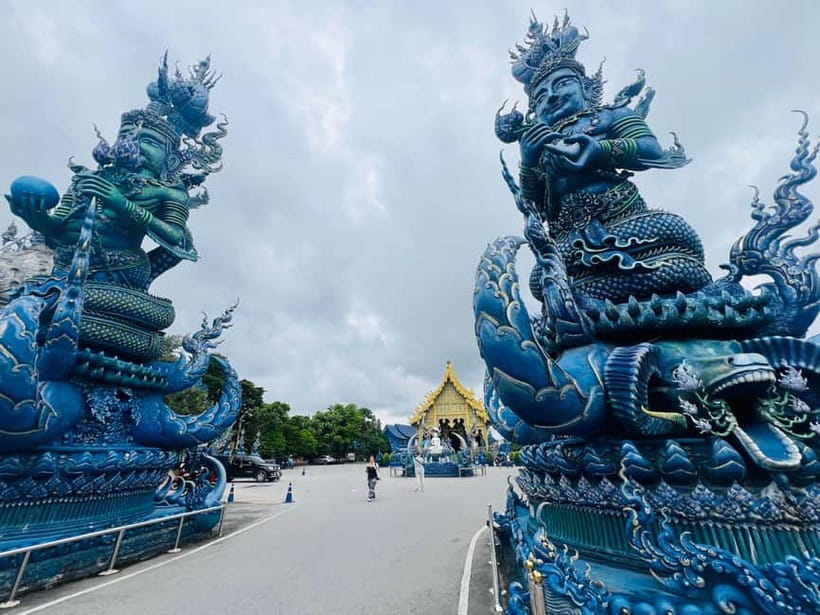
- Wat Rong Suea Ten in electric blue: deep blue hues with golden details, plus a white Buddha and celestial murals inside.
- Huay Pla Kang’s Guan Yin is a real sky-scraper: 79-meter statue with elevator access for big panoramic views.
- Route choice changes the feel: either add the Black House Museum or swap in the Red Temple (Big Buddha) plus Lalitta Café.
- Lalitta Café is the perfect reset: a fairy-tale café break designed for relaxed coffee time.
- Long van day: you’ll sit a lot, so pack light, bring sunglasses, and plan for the early start.
The Chiang Mai to Chiang Rai ride: early start, lots of seats
This is a straight-up day trip. You’ll meet at Starbucks, Tha Phae Gate branch at 7:30 a.m. If you stay in Chiang Mai Old City, pickup may be available within a 3 km radius (07:00–07:30). If you’re outside the Old City, you’ll meet at that Starbucks.
The van ride to Chiang Rai is about 1.5 hours, and you’ll do that rhythm multiple times. That matters because it shapes the whole day: it is not a slow crawl with extra time to drift. It’s more like a smart sampler, hitting the icons while still giving short breaks for food and sightseeing.
Bring sunglasses and cash. You’re also asked to bring a passport-sized photo. (Why? The information provided doesn’t spell it out, but it’s part of what the tour requests—so I’d follow that.)
Also read the fine print for your body. This tour is not suitable for people with motion sickness, and it’s not recommended for people over 70. If you’re sensitive to bumpy roads, you’ll feel it long before the first temple.
A few more Chiang Mai tours and experiences worth a look
Wat Rong Khun (White Temple): mirrored purity and the Bridge of Rebirth
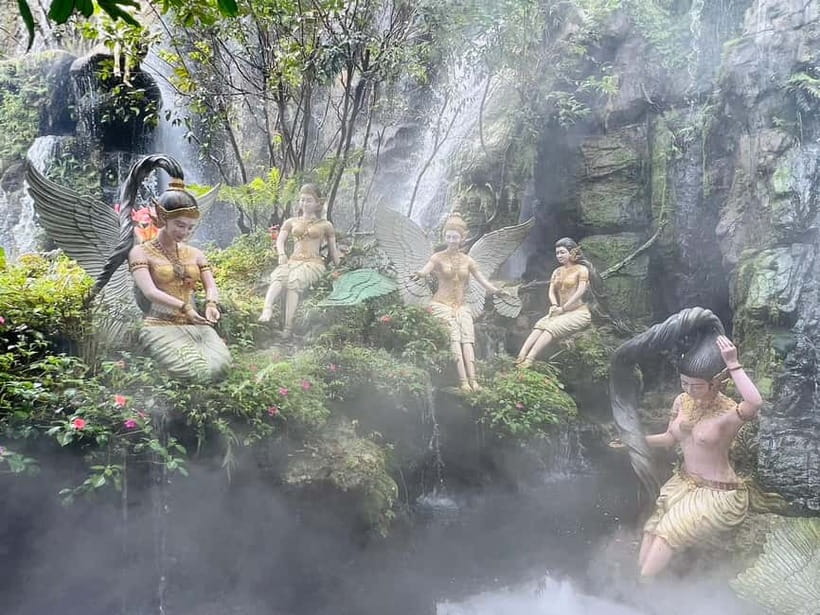
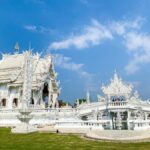
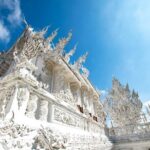
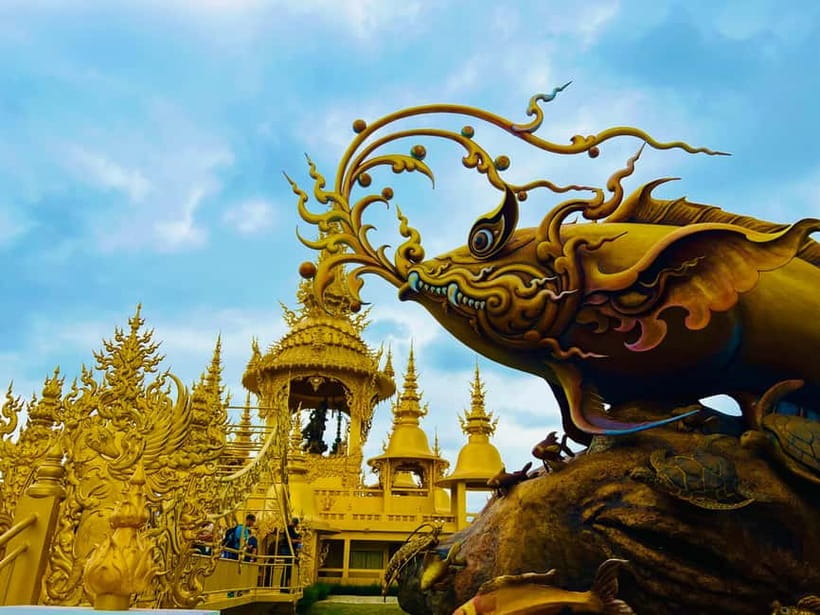
Wat Rong Khun is the big signature move: the White Temple by Chalermchai Kositpipat. The facade is white and highly detailed, and the effect gets even stronger in sunlight because of the mirrored mosaic work that catches and throws light around.
The most memorable moment is crossing the Bridge of Rebirth. It’s not just a decorative walkway. It sets a visual and symbolic tone before you even reach the main halls—like the temple is asking you to step into a different world for a bit.
What I’d plan for: you’ll want time to walk, look up, and take photos without feeling rushed. Your visit time is about 1 hour, which can be tight if you stop for every single angle. Go in with a simple strategy: one wide-angle shot for the facade, then a few close shots for the mirrored details, and don’t forget to look at what’s around the edges of the bridge too.
One balanced note from real-world experience: the White Temple can feel very tourist-facing. It can also feel more like art you look at than a place you slowly study. If you’re hoping for a guided sermon on Buddhist symbolism at every step, the tour format may not fully match that expectation. You’ll likely get orientation, then time to explore.
Wat Rong Suea Ten (Blue Temple): golden accents inside a sapphire mood
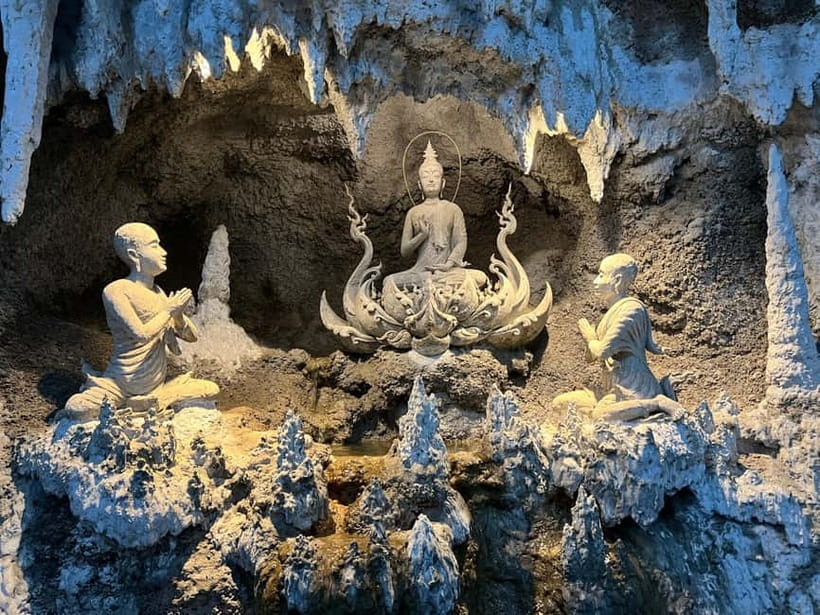
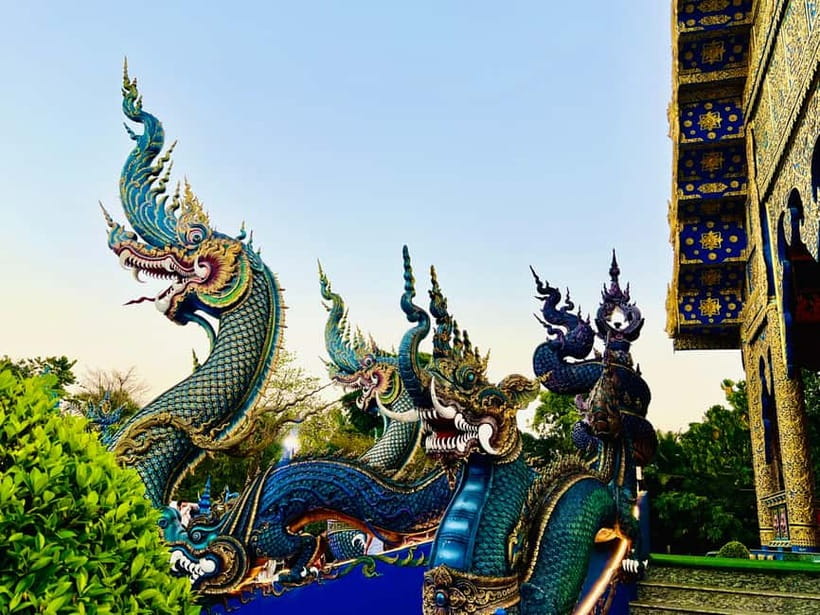
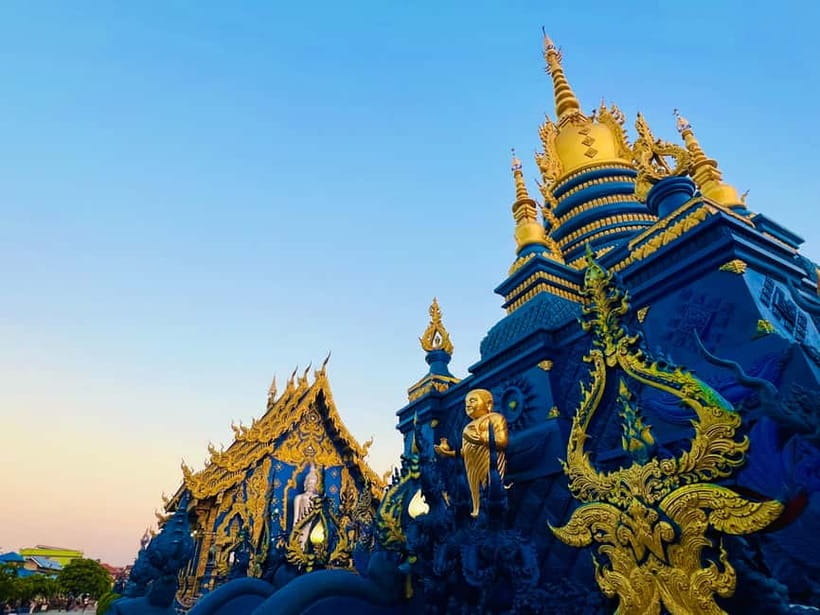
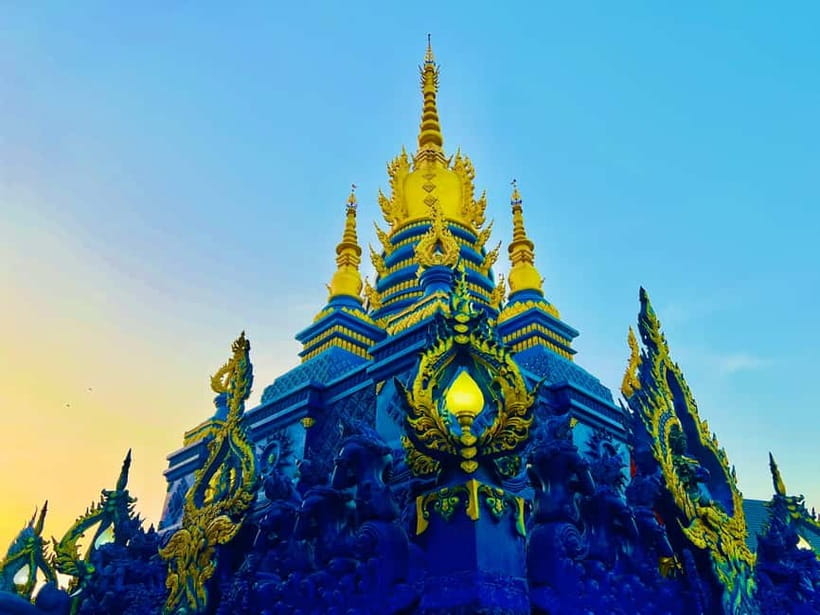
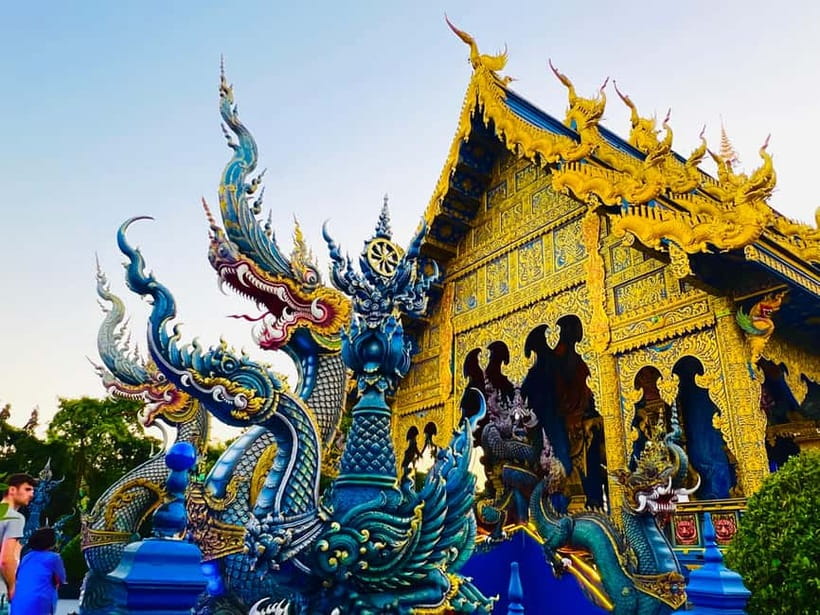
Next comes Wat Rong Suea Ten, often called the Blue Temple. The outside is striking for its deep blue tones with golden details. Inside, the mood shifts again: you’ll find a majestic white Buddha among celestial murals.
This stop is about 40 minutes. That sounds short until you realize the place is designed for fast visual hits. Here, you’re not meant to “tour” like a museum with labels everywhere. You’re meant to absorb color, form, and composition—then move on before your eyes go numb.
If you love temples that feel like modern design meeting Buddhist space, this is a good match. The Blue Temple was designed by a student of Chalermchai Kositpipat, and that connection shows in the way the artistry feels intentional rather than accidental.
A practical tip: treat this as your second photo window. You’ll have already started the day with White Temple excitement, so pace yourself. Look for symmetry and how the murals frame the central Buddha.
Huay Pla Kang Temple: the 79-meter Guan Yin and the elevator views
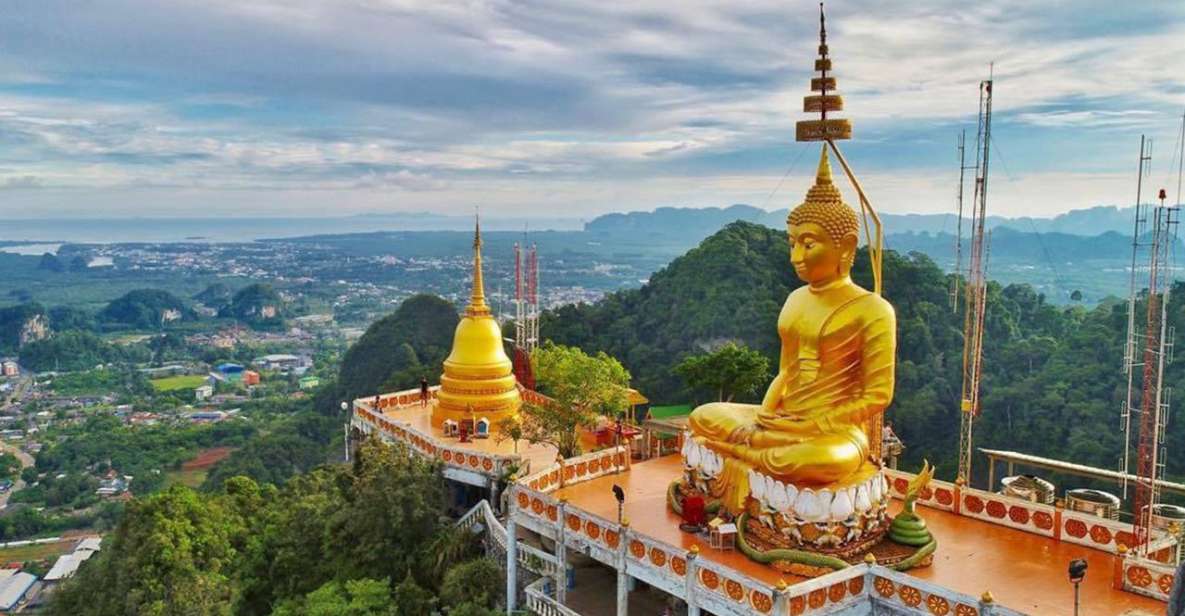
Huay Pla Kang is where the trip stops feeling like a checklist. The headline is the 79-meter-tall Guan Yin statue overlooking the area. It’s the kind of structure you see from far away, and then you still have to walk toward it to fully get the scale.
You’ll also get the option to use an elevator inside for panoramic views. That matters because it turns this from a “look from ground level” stop into an actual viewpoint moment. And nearby, there’s a carved white pagoda you can wander around.
You’ll spend about 40 minutes here. For me, the sweet spot is: first, take in the view; then go for the statue details; then finish with a slower walk around the pagoda area.
This is also a nice emotional reset after two highly designed temple spaces. Huay Pla Kang feels more monumental and less like a photo set. If you like big form and open-air perspectives, you’ll probably enjoy it more than you expect.
Black House (Baan Dam) and the Red Temple Big Buddha: how the route choice changes your day
The tour runs on two main route options after the White and Blue Temples:
- Route option A: White Temple → Blue Temple → Red Temple (Big Buddha) → Lalitta Café
- Route option B: White Temple → Blue Temple → Black House Museum (Baan Dam)
This is important because it affects the vibe. The Red Temple (Big Buddha) and the Black House are not the same kind of experience.
The Black House (Baan Dam) is described as a mysterious art museum combining traditional Lanna architecture with dark, provocative modern art. If you’re tired of only bright religious imagery, this is the left turn that makes Chiang Rai feel more interesting and a bit offbeat.
In contrast, the Red Temple (Big Buddha) is still a temple stop, but framed by a giant Buddha presence. It tends to be more spiritual-looking, more classic “temple icon” energy.
Whichever option you choose, don’t over-plan your expectations. The schedule is built for quick impressions. That can be great if you want variety without spending days in the north. It can feel like a tradeoff if you’re hoping for deep time at fewer places.


Lalitta Café: fairy-tale coffee and a calmer rhythm
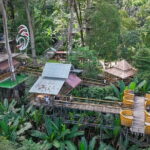
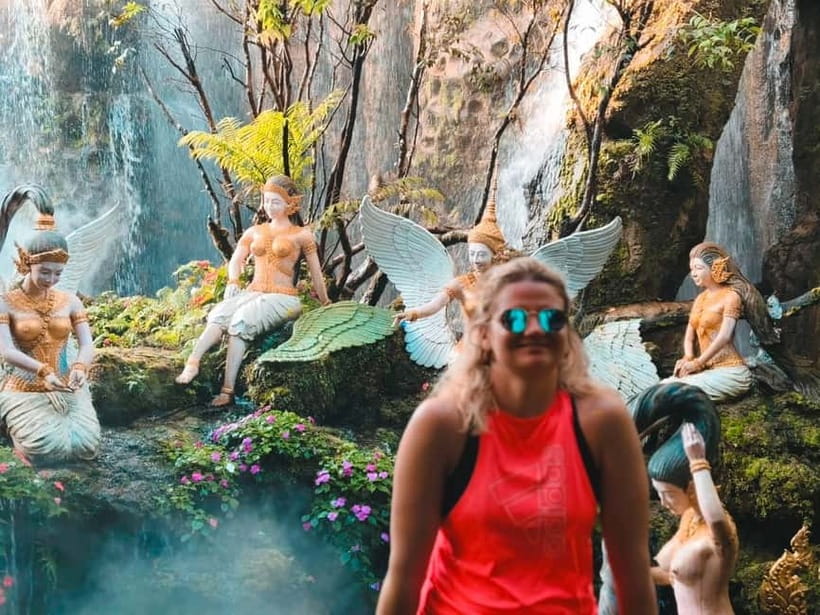
Lalitta Café is where you get a break that feels like a mood shift rather than just lunch time. The setting is described as dreamy, fairy-tale-like, and surrounded by waterfalls and lush greenery.
Your café time is about 30 minutes, with a coffee tasting component included. Some people also report getting a discount ticket for Lalitta Café, which makes it a bit easier to justify if you want extra drinks beyond the tasting.
Here’s how I’d use the time: sit down early enough to enjoy the setting before you start thinking about the next long drive. If you’re the type who always feels rushed at cafés, this is a good place to slow down for half an hour.
It’s also one of the few parts of the day designed to feel light and social, not just visual.
Optional Long Neck Karen Village and Mae Kachan Hot Springs: what to do with spare energy
You may see two extra nature/culture add-ons depending on your chosen path and what the day includes.
Long Neck Karen Village (optional)
The Long Neck Karen Village visit takes about 30 minutes, and the entrance fee is 300 THB if you choose to go. Since it’s labeled optional, you should decide based on your own comfort level with cultural tourism formats. If you care most about temples and art, you might skip it and keep the day focused.
Mae Kachan Hot Spring
There’s also a break at Mae Kachan Hot Spring for about 15 minutes. That’s not a full soak and spa day. Think of it as a quick stretch-and-reset stop, a chance to cool down your brain after temples.
If you hate short breaks, skip this expectation trap: don’t plan on hot-spring recovery. Plan on a quick pause.
Price and real value at about $48
The big selling point here is what you don’t have to manage yourself. For around $48 per person, you get:
- transportation by van
- an English-speaking guide
- entrance fees for the standard temple activities
- lunch
- drinking water
- insurance
What’s not included: Long Neck Village entrance fee (300 THB) if you opt in.
So is $48 worth it? For most people doing Chiang Rai as a one-day add-on from Chiang Mai, yes—because the hardest parts are not the temples. It’s coordinating transport, timing, and entrances across multiple sites. This tour does that for you.
The tradeoff is that you’re paying for efficiency. That’s why some visitors feel it can be a bit too temple-heavy with a lot of time in the car. If you’re someone who wants fewer stops with longer, deeper exploration, you may feel rushed.
Still, if you want the headline sights—Wat Rong Khun, Wat Rong Suea Ten, Huay Pla Kang, and then either Baan Dam or the Red Temple plus Lalitta Café—this pricing is hard to beat for the structure you get.
My take: who should book this day trip from Chiang Mai
Book it if you:
- want a high-impact Chiang Rai day trip with iconic stops
- love art-forward temples and dramatic architecture
- prefer guided logistics over self-planning across the province
- like a mix of spiritual sites plus modern art (especially if you choose Black House)
You might skip it if you:
- get motion sickness easily (the ride is long, and you’ll do it more than once)
- want deep cultural context at every temple stop
- dislike “quick hit” itineraries and would rather linger
And if you do book, choose your route based on what you crave more:
- More art-as-oddity: pick the Black House (Baan Dam) route.
- More classic icon energy plus café time: pick the Red Temple (Big Buddha) and Lalitta Café route.
Should you book?
If you’re doing Chiang Mai and want Chiang Rai’s biggest names without losing half your day to planning, this tour is a solid choice. The temples are truly the star—especially the White Temple’s mirrored details and the Blue Temple’s inside murals—and Huay Pla Kang adds a wow scale you don’t get in smaller stops.
But be honest with yourself about pace. You’ll spend serious time on the van, and temple commentary may be more briefing than full, on-site storytelling. If you can handle that tradeoff, I think you’ll walk away feeling like you did Chiang Rai properly in one day.
FAQ
Where does the tour meet?
The meeting point is Starbucks, Thapae Gate branch at 7:30 a.m.
Is hotel pickup included?
Pickup is optional. Hotel transfer service is available only for guests staying within Chiang Mai Old City (07:00–07:30). Guests staying outside the Old City must meet at the Starbucks, Tha Phae Gate branch.
What time does pickup start?
The pick-up starts at 07:00 a.m. (with a slight delay possible). You should be at the meeting point before the scheduled time.
How long is the tour?
It’s listed as a 1-day experience.
What is included in the price?
Transportation, a guide (English), entrance fees for the standard temple activities, insurance, lunch, and drinking water.
Is the Long Neck Village included?
The Long Neck Village is optional. If you choose it, there is an entrance fee of 300 THB.
Does the itinerary include Black House and Lalitta Café?
There are two route options. One includes the Red Temple (Big Buddha) and Lalitta Café, and the other includes the Black House Museum.
What should I bring?
Bring sunglasses, cash, and a passport-sized photo.
Is it suitable for motion sickness or older travelers?
It is not suitable for people with motion sickness, and it is not suitable for people over 70.
What is the cancellation policy?
Free cancellation is available up to 24 hours in advance for a full refund.