REVIEW · CHIANG MAI
Half Day Traditional Handicraft Craftsmanship Tour from Chiang Mai
Book on Viator →Operated by Sightseeingbangkok.com · Bookable on Viator
Craft street magic in four hours. This is a hands-on Thai handicraft route through San Kamphaeng Road and Bo Sang, paced by a guide and kept to a max group size of 10. You get to watch real workshop work—without the nonstop hard-sell vibe that can happen elsewhere.
I especially liked the chance to see hand-weaving silk up close, where you can actually follow the steps from thread to finished cloth. And at Bo Sang, the umbrella process is the kind of skill you can’t fully appreciate from photos—mulberry paper turns into parasols, one careful stage at a time.
One thing to keep in mind: this tour is mostly watching and touring, not sitting down to make things yourself. If you’re hoping for hours of hands-on crafting, the half-day format may feel a bit like a high-speed museum visit—just with better scenery and more chances to buy.
In This Review
- Key highlights you’ll notice fast
- San Kamphaeng Road and Bo Sang: the craft belt of Chiang Mai
- Price and what $65 really buys you
- Morning logistics: 8:00 start, small group, and comfy shoes
- Stop 1: San Kamphaeng district transfer and orientation
- Stop 2: San Kamphaeng Saturday walking street and hand-weaving silk
- Stop 3: Baan Jang Nak and the work behind elephant wood carvings
- Stop 4: Bo Sang umbrella village and Saa-paper parasols from scratch
- Shopping without buyer’s regret: how to spend your baht (or don’t)
- Who should book this craft tour in Chiang Mai
- Should you book this half-day traditional handicraft tour?
- FAQ
- How long is the tour?
- What time does the tour start?
- Is hotel pickup included?
- Is there a pickup fee outside the city center?
- How many people are in the group?
- Is the vehicle air-conditioned?
- Are admission tickets included?
- What should I wear?
- Is the tour suitable for children?
- Is cancellation free?
Key highlights you’ll notice fast
- Small-group feel (up to 10 people) with personal guidance at each stop
- Silk weaving demonstrations on San Kamphaeng Road
- Elephant wood carving focus at Baan Jang Nak
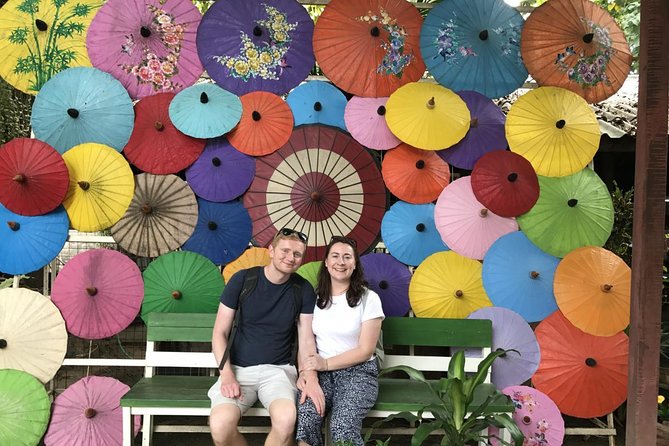
- Bo Sang umbrella making using Saa-paper from scratch
- Free admissions at the listed stops
- Door-to-door pickup in Chiang Mai’s city-center zone
San Kamphaeng Road and Bo Sang: the craft belt of Chiang Mai
If you’ve got a morning in Chiang Mai and you want something more interesting than markets-with-pigeons, this route makes sense. San Kamphaeng Road is where craft production clusters, so you’re not driving all over town chasing random shops. Bo Sang (umbrella village) is famous for a specific craft skill, which means you get depth instead of scatter.
The best part is the pace. You’re not stuck in one store for the entire tour. You move between silk, wood carving, and umbrella making—three different crafts with different tools, techniques, and textures. Even if you don’t buy anything, you’ll walk away with a clearer sense of how Thai artisan work is organized: raw materials, repeated steps, and lots of careful finishing.
You can also read our reviews of more tours and experiences in Chiang Mai.



Price and what $65 really buys you
At $65 per person for about 4 hours, the value comes from the combo: guide + transport + multiple craft stops. In practice, that’s what keeps this from feeling like you’re just paying for a ride.
Here’s what you’re getting for your money:
- A guided visit through handicraft factories and workshops in the Sankampaeng area
- Hotel pickup and drop-off if you’re within the free city-center zone
- An air-conditioned vehicle for the transfers
- Admission is listed as free at each of the stops
If you were to do this on your own, you’d still need transport, and you might end up paying for entry to at least one attraction. The guide’s job is to connect what you’re seeing—especially when processes take time and look “mysterious” at first.
Morning logistics: 8:00 start, small group, and comfy shoes
The tour starts at 8:00 am, which is a smart time to see craft neighborhoods before the day fully warms up. You’ll be picked up from selected central hotels, or you can join at the meeting point at McDonald’s at Chiang Mai Night Bazaar.
The free pickup zone covers the city center area within about 3 km radius, including places like Night Bazaar, Tapae Gate, Chiang Mai Gate, Suan Dok gate, the old city, and some nearby roads (Huay Kaew Road, Ibis Hotel area, Nimmana Haeminda Road, Santitham area). If your hotel is outside the city center—specifically more than 5 km from the 3 Kings Monument—there’s a 300 THB pickup/drop-off surcharge paid on the day.
Wear comfortable walking shoes. Even though the tour isn’t a hiking day, craft districts reward short walks and close viewing, especially around markets and village lanes.
Stop 1: San Kamphaeng district transfer and orientation
This is the short breather before you hit the workshops. You’ll travel from your hotel to the Sankampaeng district (about 30 minutes), and the admission for this first segment is listed as free.
What you’re gaining here is context. The guide sets up what you’ll be looking for later—how silk differs from wood products, and why umbrella manufacturing has its own rhythm. If you’re the type who likes to understand what your eyes are landing on, this first transition helps you appreciate the rest more.
Stop 2: San Kamphaeng Saturday walking street and hand-weaving silk
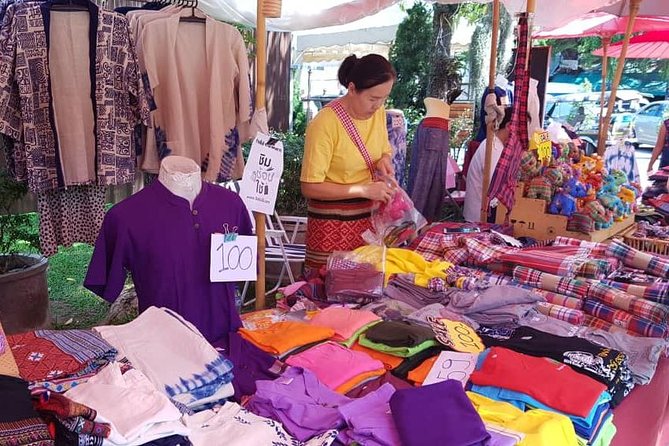
This is where the tour earns its “watch craftsmanship” reputation. You’ll visit the San Kamphaeng Saturday walking street market, which sits right in the center of Thailand’s handicraft production. (That “Saturday” detail matters—this stop is described as the Saturday walking street.)
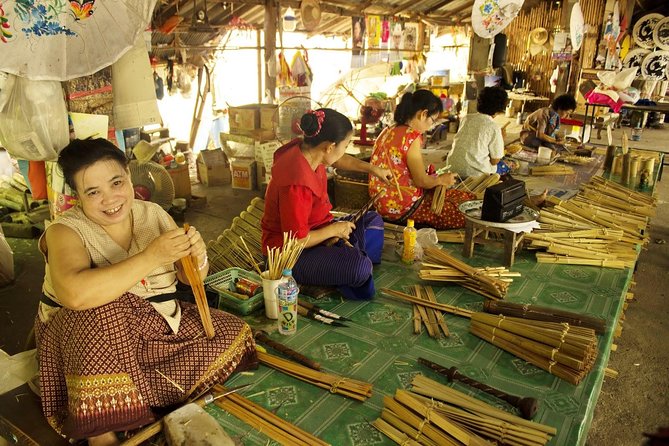
You’ll see workshops and factories where locals demonstrate hand weaving silk. The tour also focuses on the process of silk production, not just the final bolts of fabric.
A few practical things to know:
- Expect to do some close-range looking and standing in place while the guide explains what you’re seeing.
- Silk weaving looks simple at a distance, but up close it’s all about repetition, tension control, and finishing details.
- It’s a good moment to ask questions about how long steps take and why certain materials are chosen—your guide is the shortcut to making sense of it.
Also, silk is where you’ll likely feel the pull to shop. That’s not automatically bad. Just keep your expectations grounded: if you want a bargain, set a budget and be ready to compare. If you want quality, your best tool is attention—notice stitch tightness, finishing, and how fabrics drape.






Stop 3: Baan Jang Nak and the work behind elephant wood carvings
Next up is Baan Jang Nak – a Museum of Elephant Wood Carvings. The stop is described as going through a renowned wood and furniture factory, so you’re not only seeing finished pieces—you’re getting a sense of the steps that turn raw material into products.
This is a great stop if you like “how it’s made” experiences. Wood carving is one of those crafts where the magic is actually in the workflow: shaping, smoothing, detailing, and finishing, all repeated until the design becomes crisp.
You’ll also see an exhibit showing locally made native costumes, jewelry, and home novelties at a nearby handicrafts center. That matters because it broadens the definition of craft in your head. It’s not only about wood and furniture. It’s craft as a whole economy of handmade objects.
One consideration: wood and furniture factories can be visually intense. If you’re sensitive to crowds or prefer quiet galleries, you might want a bit of patience while you wait for your guide to translate what you’re looking at. But if you’re there for craftsmanship, the noise and activity are part of the point.
Stop 4: Bo Sang umbrella village and Saa-paper parasols from scratch
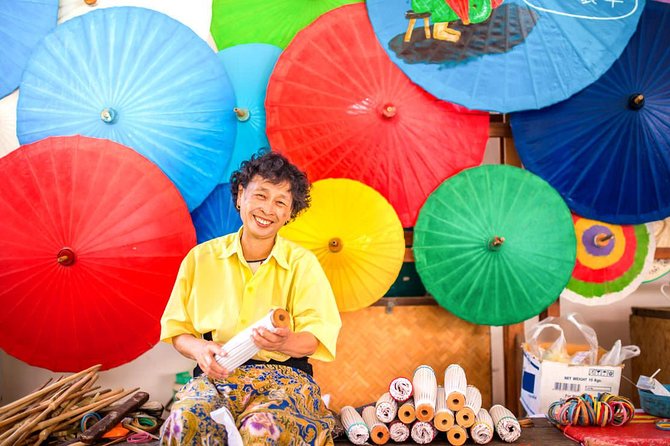
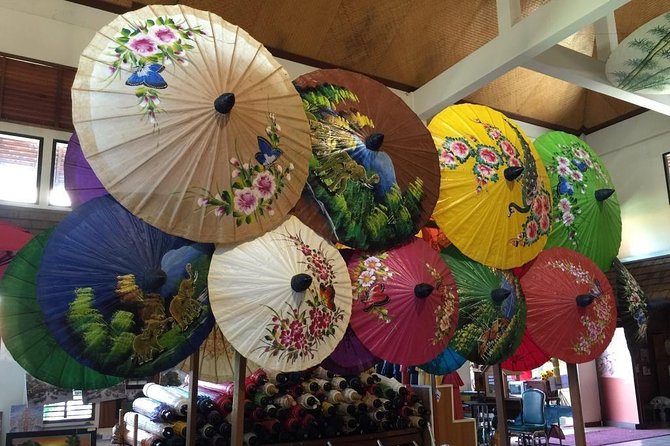
Bo Sang (often spelled Bo Sang) is famous for Saa-paper umbrellas. The tour description is clear: you’ll see how umbrellas are made from scratch.
What I like about umbrella-making as a craft stop is that you can follow the logic of the materials. Saa paper has its own handling needs, and umbrella structure isn’t just decoration—it’s engineering disguised as a household item. When you watch the steps, you start to understand why certain designs cost more: more stages, more careful shaping, more time spent getting consistent results.
After the main umbrella-making portion, you’ll have time to wander around the district and interact with locals. This is also your practical shopping window. If you’re going to buy anything, this is where you can actually connect the object to the process you just watched.
Shopping without buyer’s regret: how to spend your baht (or don’t)
This tour doesn’t sell itself as a pressure-cooker, and the small-group size helps keep the atmosphere calmer. Still, craft districts are retail districts. You’ll see “mementos” and you’ll be tempted.
My advice is simple:
- Decide your goal before you go: gift, personal keepsake, or just photos.
- If you’re buying, treat the tour like research. Look at what the artisans are doing, then compare what’s for sale to the techniques you saw.
- Bring a realistic budget. Handmade crafts can be priced like handmade crafts.
A fun detail I picked up from the guide experience (and it’s worth listening for) is that craft knowledge often overlaps. One guide I encountered—her name sounded like Ms Ooh Lala—pointed out multiple craft enterprises and examples, including celadon work where it’s thrown, glazed, and painted. That kind of cross-craft context makes the day more than a checklist.
Who should book this craft tour in Chiang Mai
This tour fits you best if:
- You want a structured way to see craft zones like San Kamphaeng Road and Bo Sang
- You like watching skilled workers explain processes with a guide
- You want a half-day plan that doesn’t require advanced planning
It’s also a good pick for first-timers. The route helps you understand what Chiang Mai is doing beyond temples and night markets.
You might skip it if:
- You mainly want hands-on crafting time (this is mostly observation and touring)
- You prefer fully independent travel with no set itinerary
- You’re the type who hates factory-style environments, even when they’re interesting
Should you book this half-day traditional handicraft tour?
If you’re short on time and you want the fastest path to seeing three real Thai craft specialities—silk weaving, wood carving, and umbrella making—I’d book this. The small-group size, guided interpretation, and hotel pickup make it feel efficient instead of stressful.
But if you’re hoping to actually sit down and produce your own souvenirs, plan something else alongside this tour (or choose a workshop-style experience). For a guided look at craftsmanship and the chance to buy with your eyes open, this half-day format is a smart, practical use of a Chiang Mai morning.
FAQ
How long is the tour?
The tour runs for about 4 hours.
What time does the tour start?
It starts at 8:00 am.
Is hotel pickup included?
Hotel pickup and drop-off are included for selected hotels.
Is there a pickup fee outside the city center?
Yes. A 300 THB surcharge applies for pickup/drop-off in hotels outside the city center area (outside about 5 km from the 3 Kings Monument). It’s paid on the day.
How many people are in the group?
The tour has a maximum of 10 travelers.
Is the vehicle air-conditioned?
Yes. An air-conditioned vehicle is included.
Are admission tickets included?
Admission is listed as free for the stops on the itinerary.
What should I wear?
Wear comfortable walking shoes.
Is the tour suitable for children?
Children must be accompanied by an adult.
Is cancellation free?
Yes, free cancellation is offered. You can cancel up to 24 hours in advance for a full refund.