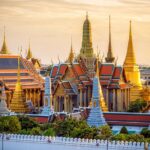
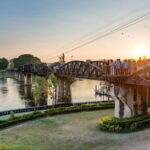
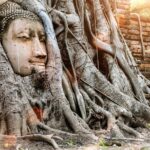
Bangkok doesn’t do small. This tour strings together historic Siam sights with real neighborhood streets, so you get the city’s big stories and daily life in one walk (or two). You’ll also get a mobile ticket and built-in self-guiding help through the Vox City app.
I like the way the route pairs crowd-pleasers like Wat Pho and Wat Traimit with the off-main-street details that make Bangkok feel lived-in. I love that the ticket gives you flexibility over a few days, not just one rushed morning. One catch: entry to attractions and food are not included, so budget extra if you want to go inside everything.
In This Review
- Key highlights
- A flexible ticket that lets you move at Bangkok speed
- How the Vox City app turns stops into real stories
- From gold Buddhas to the Reclining Buddha at Wat Pho
- Old Bangkok: Buddhist temples, canals, and Fort Mahakan
- Neighborhood Bangkok: Buddha shops, Chinese temples, and Little India
- Museum of Siam: learning Thailand’s big story without a lecture
- Wat Ratchanatdaram UNESCO spires and the climb to Wat Sa Ket
- The Giant Swing, Wat Suthat, and the sacred scale of Bangkok
- Pak Khlong Talat flowers and the rhythm of 24/7 markets
- Chinatown Gate, Sampheng markets, and the feel of streets as culture
- Siam Square, shopping malls, and the in-between lanes
- Royal Bangkok transitions: King Prajadhipok Museum and Saranrom Palace Park
- Western medicine history at the Berlin Pharmaceutical Museum
- Wat Traimit: seeing a 5.5-ton golden Buddha in real life
- Food and adult nightlife: plan your day with eyes open
- Price and value: why $24 can make sense here
- What kind of traveler this suits best
- Final call: should you book this Bangkok walking tour ticket?
- FAQ
- How long is the walking tour?
- What’s the ticket validity period if I can’t go on the same day?
- What does the tour include?
- Is transportation included?
- Are entry fees for temples and attractions included?
- Are food and drinks included?
- Can I cancel for a full refund?
Key highlights
- Flexible 3-day use window once you start, so you’re not forced into one exact day
- Vox City app with 7 self-guided walks plus audio commentary in 5 languages
- Temple-to-market contrast, from gold Buddhas and grand shrines to Phahurat and Sampheng
- Iconic landmarks on foot, including Wat Pho’s Reclining Buddha and Wat Traimit’s solid-gold Buddha
- History touchpoints beyond temples, from Fort Mahakan to Museum of Siam and the Berlin Pharmaceutical Museum
A flexible ticket that lets you move at Bangkok speed
The big value here is the pacing. You’re not locked into one single, rigid schedule. The guided walking tours are designed to run about 1 to 2 hours, but your ticket works as a 2-day ticket with extra breathing room: it’s valid for 3 days from first use. That’s perfect if your Bangkok plans shift—because they will.
Also, this isn’t just a walking route with a start and finish. It’s a mix of guided segments (the best way to get context fast) plus self-guided options through the Vox City app. Translation: you can take the tour today, then use the app later to connect the dots when you’re ready to explore on your own.
One more practical detail: transportation is not included. So think of this as a walk-first experience. It’s easiest when you can reach each start point by public transit nearby.
You can also read our reviews of more walking tours in Bangkok
How the Vox City app turns stops into real stories
Included with your ticket is the Vox City app with 7 self-guided walking tours and audio commentary in 5 languages. That matters more than it sounds.
A guided walk is great for orientation: what to look at, what dates matter, and which details are worth your time. But the app extends the experience into the rest of your stay. After you’ve seen something like Wat Pho, you can later revisit the theme—temples, royal Bangkok, Chinese community landmarks, and so on—and keep learning without paying for extra tours.
The audio format also makes it easier to manage Bangkok’s constant motion. If you’re tired, you can slow down with the commentary. If you’re hungry, you can pause the experience and come back to the route when you’re ready. That’s a big deal on a city that never fully “waits” for you.
From gold Buddhas to the Reclining Buddha at Wat Pho
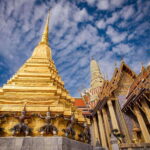
Wat Pho is one of those places where you feel the scale immediately. It’s one of Thailand’s largest and most important temples, and the complex includes more than 1,000 Buddha images and statues. The star attraction is the Reclining Buddha (Phra Buddha Saiya).
Why this stop is so valuable on a walking tour: it’s not only a landmark. It’s a visual lesson. When you see so many Buddha images in one place, you start understanding how Thai Buddhist culture expresses devotion in art—repetition, detail, and symbolism all at once.
Practical tip: because entry is not included, check whether you’re planning to go inside specific temple areas during your walk. Budget for it, so the experience doesn’t feel like an unfinished assignment.
Old Bangkok: Buddhist temples, canals, and Fort Mahakan
The walk’s “old Bangkok” section gives you the flavor of the city before the skyline. One stop focuses on old Buddhist temples in traditional Thai settings, with an ornate marble exterior and a gold Buddha. It’s the kind of detail that’s hard to pick up on your own when you’re just passing through streets.
Then there’s Pi Kun Bridge—named as a pedestrian overpass across Khlong Khu Mueang Doem, also known as Khlong Lot (tube canal). You don’t just cross it; you get a sense of how water shaped the old city layout and movement.
Fort Mahakan is another anchor. Built in the 18th century, it’s described as one of Bangkok’s oldest structures. That’s a key contrast to the more decorative temple stops. Forts are about defense and boundaries; they change how you read the neighborhood around them.
And then Rommaninat Park adds a twist. It’s a place to walk under flowers and trees, but it also connects to the darker side of the past. The park is linked to the old Bangkok prison, now turned into a museum where you can retrace parts of Thailand’s prison history.
If you like history that includes the uncomfortable bits (not just the pretty ones), this section will feel like a real win.
Neighborhood Bangkok: Buddha shops, Chinese temples, and Little India
Bangkok’s identity shows up best in neighborhoods. This tour uses that principle well, moving between communities so you see how the city changes block by block.
In the older neighborhood street area, you’ll see shops selling Buddha statues and other memorabilia. It’s not just souvenir browsing. It’s also a window into what people value and buy for daily religious life—small objects that carry big meaning.
You also hit one of Bangkok’s major Chinese temple stops: Wat Mangkon Kamalawat. It’s identified as the largest and most important Chinese temple in Bangkok, established in 1871, originally named Wat Leng Noei Yi. That gives you a concrete historical anchor for the Chinese community’s presence in Bangkok.
And then there’s Phahurat Market, known as Bangkok’s Little India, a focal point of Indian life in the area. Pair that with Sampheng, a historic market neighborhood in Chinatown, and you get a tour that doesn’t treat religion and culture as museum categories. It treats them like living geography.
You can also read our reviews of more historical tours in Bangkok


Museum of Siam: learning Thailand’s big story without a lecture
Museum of Siam is included as a historical anchor. It’s described as the country’s first national discovery museum, established in the mid-2000s.
What makes a stop like this useful on a walking tour: it provides context for everything you’re seeing outside. Temples, royal landmarks, and national transitions start to click when you know the outline—especially when Bangkok’s landmarks connect to changes in government and identity.
Even if you don’t spend hours inside (time varies by pace and interest), it’s the kind of break that turns wandering into understanding.
Wat Ratchanatdaram UNESCO spires and the climb to Wat Sa Ket
Some stops are there because they’re famous. Others are there because they’re famous for a reason.
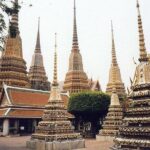
Wat Ratchanatdaram is listed as a UNESCO World Heritage Site and is described with 37 bronze golden spires, plus landmarks right next to it like the Royal Reception Pavilion and three minor pavilions. That’s one of those places where the “I’ll just look for a minute” plan disappears fast. The structure is visual math: order, height, repetition, and placement.
Then you climb to Wat Sa Ket on a 75-meter (246 ft) tall artificial hill. The effort is described as worth it, and the temple’s building is noted as golden bell-shaped, with vibrant colored walls, detailed paintings, and miniature sculptures inside.
Here’s the practical angle: since entry is not included, plan for costs and timing if you want the full interior experience. Also, wear shoes that handle uneven surfaces and stairs comfortably.
The Giant Swing, Wat Suthat, and the sacred scale of Bangkok
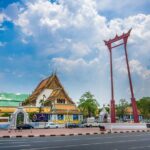
Right in front of Wat Suthat, you’ll learn about the Giant Swing, described as a massive religious structure tied to one of Bangkok’s oldest and most impressive temples.
Why this is a strong walking-tour stop: it’s hard to understand scale from photos. On the ground, the size becomes obvious, and your questions start forming naturally—what it’s for, who it served, and why something so tall belongs in the middle of a city space.
If you care about architecture that serves ritual—not just decoration—this stop gives you that.
Pak Khlong Talat flowers and the rhythm of 24/7 markets
Pak Khlong Talat is included as one of Bangkok’s most popular flower markets, and it’s noted as open 24/7. It sells fruits and vegetables too, but flowers are the main event, sourced from across Thailand.
This is one of those stops that feels alive even if you’re not a big shopper. You’re watching logistics and craftsmanship in motion. Flower markets also show you what Bangkok values in daily life—ritual, celebration, and offering.
If you go in the evening, you might catch a different mood than during daylight. Either way, it’s a solid change of pace from temple-heavy days.
Chinatown Gate, Sampheng markets, and the feel of streets as culture
Chinatown Gate is described as an enormous red Chinese gate functioning as a roundabout, marking the center of Chinatown, with plaques covering the history of the Chinese community.
Then Sampheng keeps the momentum going. It’s described as a historic neighborhood and market in Chinatown. This pairing is smart: the gate gives you the symbolic center, and Sampheng shows you the everyday activity around it.
If you like to understand cities as systems—where people live, work, buy, and gather—these stops deliver.
Siam Square, shopping malls, and the in-between lanes
Siam Square appears as a contrast zone: massive malls on one side and lanes packed with street vendors on the other. That “two speeds in one area” feeling is very Bangkok, and it’s good that the tour doesn’t pretend the city stops at temples and palaces.
This section is useful for your practical planning too. It’s where you can reset: snack, browse, cool down, and then head back out.
The tour also mentions Krungthong Plaza and notes it’s situated nearby to City Complex Pratunam and close to Hong Gi Seafood. That tells you there’s shopping and food nearby if you want to extend your day on your own.
Royal Bangkok transitions: King Prajadhipok Museum and Saranrom Palace Park
King Prajadhipok Museum is housed in an early 1900s neoclassical mansion and focuses on the life of King Prajadipok (Rama VII). It also explains Thailand’s transition from outright monarchy to constitutional monarchy in 1932.
That transition theme matters, because Bangkok’s landmarks are tied to periods of power. When you understand the political shift, statues, pavilions, and royal spaces start making more sense.
Saranrom Palace Park adds another royal layer. It’s described as once an outdoor relaxation area reserved for the Thai Royal Family, featuring rare and native plants, centuries-old trees, colorful flowers, and memorials. If you need a break after temple crowds and market noise, this is the kind of green pause you’ll appreciate.
Western medicine history at the Berlin Pharmaceutical Museum
One of the most distinctive stops is the Berlin Pharmaceutical Museum. It pays tribute to the history of Western-style medicine introduced to Bangkok in the 1700s and commemorates Dr. Chai Chaiyanuwat. It’s located in the exact building where he practiced.
Why I think this works on a walking tour: it’s not another shrine or palace. It’s a reminder that cultural exchange moves through science and institutions too. Bangkok isn’t only religious and royal; it also absorbs global ideas and adapts them.
Wat Traimit: seeing a 5.5-ton golden Buddha in real life
Wat Traimit Withayaram Worawihan is described as one of Bangkok’s most visited temples and known for the largest golden Buddha statue in the world made of solid gold. The weight is given as 5.5 tonnes (5,500 kilograms) and the height as 3 meters (16 ft).
That kind of fact changes how you look at a temple. You stop seeing gold as decoration and start seeing it as engineering—scale, material, and craftsmanship. If you like memorable “wow” moments that still feel grounded in history, this is one of the best stops on the tour.
Food and adult nightlife: plan your day with eyes open
This experience clearly includes very different types of city spaces. On the food side, one included suggestion is Kuai Chap Uan Photchana, described as Michelin-rated street food. The claim to fame is Kuai Chap soup and taco-style dishes, with vegetarian options available.
On the other side, the route also includes an entertainment complex and red-light district in Khlong Toei. It’s described as occupying a three-story commercial building, calling itself the world’s largest adult playground.
How to handle that as a visitor: don’t treat it like a “scenic stop.” It’s a real part of the city’s economy and nightlife. If you prefer calmer streets, you can use the flexible nature of the ticket to set your comfort level—do this segment when you’re okay with it, and then switch to self-guided routes elsewhere if you want a quieter day.
Price and value: why $24 can make sense here
At $24 per person, this is priced like an accessible city experience, not a premium sightseeing package. And you’re not only paying for a walk.
You’re also getting:
- a guided portion (1 to 2 hours, roughly),
- a mobile ticket,
- the Vox City app with 7 self-guided tours,
- and audio commentary in 5 languages.
The big hidden cost risk isn’t the tour price—it’s what you choose to enter and eat, since entry tickets and food are not included. If you plan to add museum/temple admissions and meals, you’ll spend more. If you’re smart and pick what you most want to go inside, the $24 can feel like a strong value because it buys your orientation and your learning tools, not just foot traffic.
What kind of traveler this suits best
This walking tour ticket is a great fit if you:
- want a guided history-and-culture framework you can build on later,
- like mixing major sights with street-level markets and neighborhood culture,
- appreciate an app you can use later instead of only relying on the guide.
It may be less ideal if:
- you hate walking or standing for long stretches (it’s a walk-first experience),
- you dislike areas that include nightlife and adult entertainment zones,
- you want everything fully included with no extra spending (entry and food aren’t included).
Final call: should you book this Bangkok walking tour ticket?
I’d book it if you want Bangkok to make sense quickly. The combination of guided context plus the Vox City app gives you a smart way to keep learning across multiple days, and the stop list covers a wide range—from Wat Pho and Wat Traimit to markets like Pak Khlong Talat and cultural hubs like Phahurat and Chinatown.
I’d skip or adjust your expectations if you’re on a tight budget for entrances and meals, or if you’d rather avoid adult nightlife areas altogether.
If you like your Bangkok tours practical and varied, this one is worth considering.
FAQ
How long is the walking tour?
The experience runs about 1 to 2 hours (approx.).
What’s the ticket validity period if I can’t go on the same day?
Your ticket is valid for 3 days from first use.
What does the tour include?
It includes the Historic Siam walking tour and the Bangkok Cultural Gems walking tour, plus the Vox City app with 7 self-guided walking tours and audio commentary in 5 languages.
Is transportation included?
No, transportation is not included.
Are entry fees for temples and attractions included?
No, entry to attractions is not included.
Are food and drinks included?
No, food and drinks are not included.
Can I cancel for a full refund?
Yes. Free cancellation is available, and you can cancel up to 24 hours in advance for a full refund.